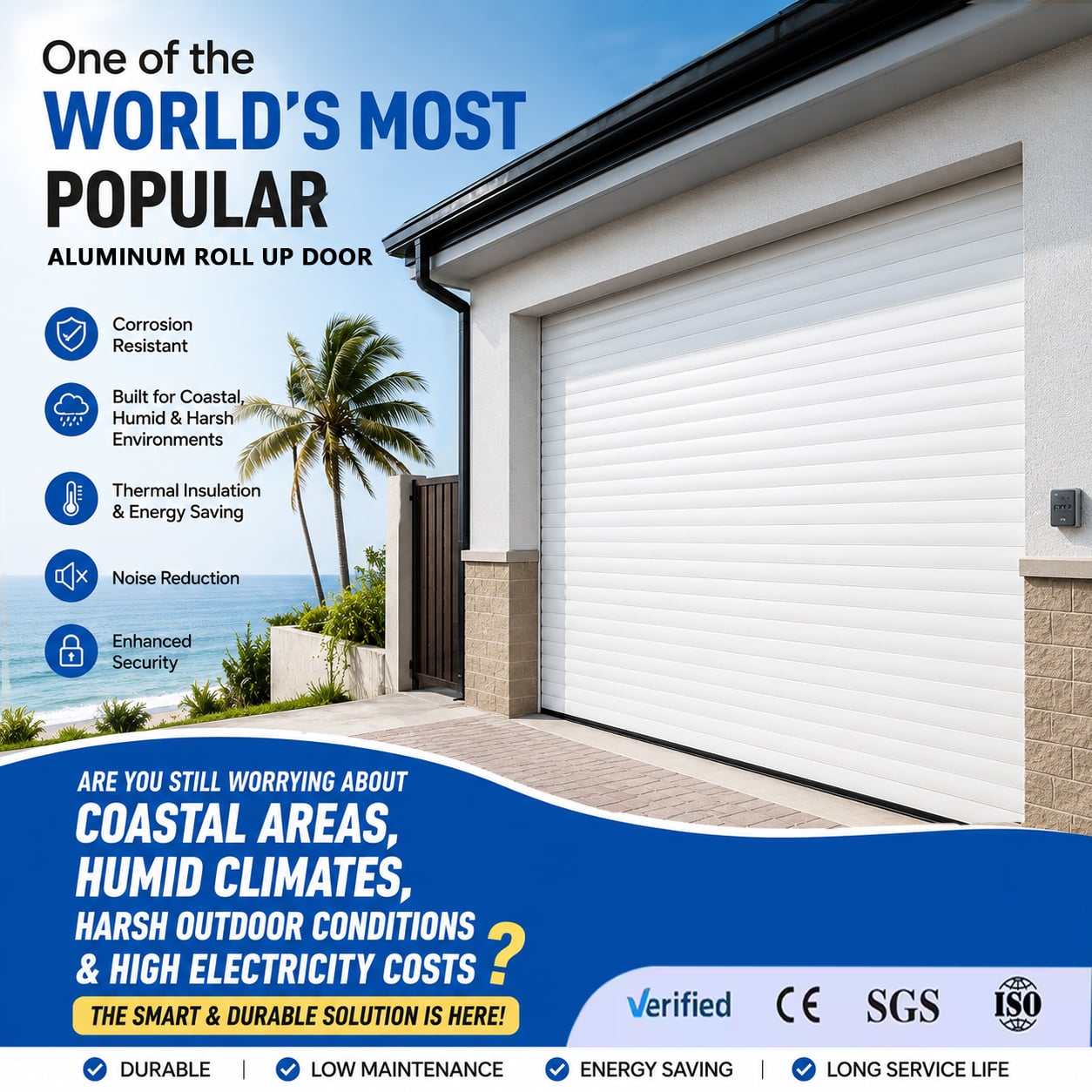

An aluminum roll up door is a retractable closure system built from interlocking aluminum alloy slats that coil around a spring-loaded drum positioned above the opening when raised. The slat profiles are typically double-sided extruded aluminum sections — selected for their combination of corrosion resistance, structural rigidity, and reduced weight compared to steel curtain alternatives. While steel roll up doors remain common in heavy industrial loading dock applications, aluminum roll up doors have become the preferred specification for commercial storefronts, warehouses, self-storage facilities, and vehicle-mounted applications where weight, long-term surface finish, and low maintenance matter to the buyer.
The product range covers manual spring-assisted, electric motor-driven, and smart remote-controlled configurations. Manual versions rely on a torsion spring counterbalance that permits one-person operation without additional power. Motorized versions integrate an electric operator with limit switches and optional remote or access-control interfaces. The right configuration is determined by actual operational requirements — cycle volume, facility access protocol, and budget for ongoing maintenance — not only by convenience preference.
Before settling on a specification, it is worth asking: what does a typical operating day look like for this door — including peak access periods, exposure conditions, and who is operating it? That answer changes several specification decisions.
In commercial and industrial real estate, aluminum roll up doors serve as primary closures for warehouses, workshops, distribution centers, and logistics facilities. The aluminum material choice is justified where high-cycle operation, long-term appearance requirements, or corrosive environment exposure rules out steel as the first-cost-equivalent alternative. In retail — storefronts, kiosks, and food service counters — the combination of aesthetic finish quality and reduced maintenance cycle makes aluminum the practical operating choice.
Self-storage facilities are a major installation segment. Developers and operators specify aluminum roll up doors for unit front closures across large numbers of identically-sized bays, where consistent batch quality across the full project order matters as much as the individual unit specification. Vehicle-mounted applications — delivery vans, cargo trucks, emergency response vehicles, and service trucks — use aluminum roll up doors specifically because weight reduction translates into payload capacity and fuel efficiency. Shipping container conversions and modular commercial structures also use aluminum roll up doors as primary access closures, where the lighter curtain reduces structural load on the container frame.
In markets including the US, Canada, the UK, and the Netherlands, fire rating requirements, structural load certifications, and energy performance standards may apply depending on the building classification and local building code. Buyers procuring for these markets should confirm the applicable standard category with the supplier before finalizing the order, and verify that the relevant documentation accompanies the shipment.
One of the more frustrating problems in roll up door procurement is discovering a dimension mismatch after delivery. The product itself may match the order specification exactly, but the actual structural opening in an existing building — particularly in older warehouse or commercial construction — is rarely identical to the nominal quoted dimension. The rough opening width and height, plus the clearance required for guide rail mounting on both sides and headroom for the drum, should all be measured and confirmed with the supplier before finalizing an order. Catching this at the specification stage costs far less than resolving it during installation.
Choosing between aluminum and steel for a roll up door curtain is a genuine trade-off, not a case of one material being universally superior. Aluminum wins on corrosion resistance and weight — which directly affects motor sizing requirements and spring wear rate — but gives ground to steel on dent resistance under direct impact loading. If the installation environment involves regular forklift proximity, vehicle traffic near the door panel, or high-impact risk, that factor should weigh heavily in the material choice. If the priorities are lightweight motorized operation, long-term surface appearance, or coastal or high-humidity exposure, aluminum justifies its premium over steel over the full product lifecycle.
On the motorized versus manual question: motorized aluminum roll up doors deliver real operational value in facilities running 50 or more door cycles per day, where the time saving and access control integration are measurable. However, motorized systems also introduce an electric operator and control circuit that require periodic service and have failure modes that a manual spring-assisted door does not. For lower-volume applications — residential storage units, single-shift retail operations, or seasonal-use buildings — manual spring-assisted operation often produces a more reliable long-term outcome with a lower total cost of ownership.
If the facility operates on a consistent single-shift access pattern with predictable cycle counts, the standard spring-assist specification is typically sufficient. If cycles vary significantly across seasons, or if the installation environment has elevated humidity, reviewing the spring load rating against actual peak-cycle conditions before placing the order is worth the additional specification time.
For B2B buyers sourcing aluminum roll up doors internationally, several factors influence delivered value beyond the unit price. Slat profile design varies meaningfully across manufacturers — specifically the cross-section geometry, wall thickness, and interlocking tolerance, which collectively determine operational smoothness, structural span capability, and long-term seal integrity at the guide rail. Requesting technical drawings or a physical sample before committing to a project volume allows these variables to be verified rather than assumed.
Spring mechanism specification is a factor that first-time buyers sometimes overlook. A spring assembly sized for a light residential or retail application will fail early in a high-cycle commercial or logistics environment, creating exactly the unplanned operational downtime that a properly specified door would have avoided. Confirming that the supplier can document how the spring specification maps to your actual operating cycle requirements is a practical differentiator when evaluating multiple suppliers.
For project-scale orders — self-storage development projects in particular — dimensional consistency across the full batch matters in addition to unit-level quality. Guide rail alignment efficiency during installation depends on consistent tolerances from unit to unit. Discussing batch consistency expectations and deviation handling with the supplier before placing a large order reduces the risk of on-site installation delays that are difficult to recover on a construction schedule.
Product selection across a wide range of size, motor, and hardware options can be complex. Buyers who define their application requirements — opening dimensions, daily cycle count, operating environment, motorization preference, and finish requirements — before approaching suppliers are better positioned to evaluate whether a given configuration actually matches their needs, rather than defaulting to whichever option is most prominently listed.
Copyright © 2026 By Qingdao Voltor Door Industry Technology Manufacturing Co., Ltd. - Privacy policy
 EN
EN