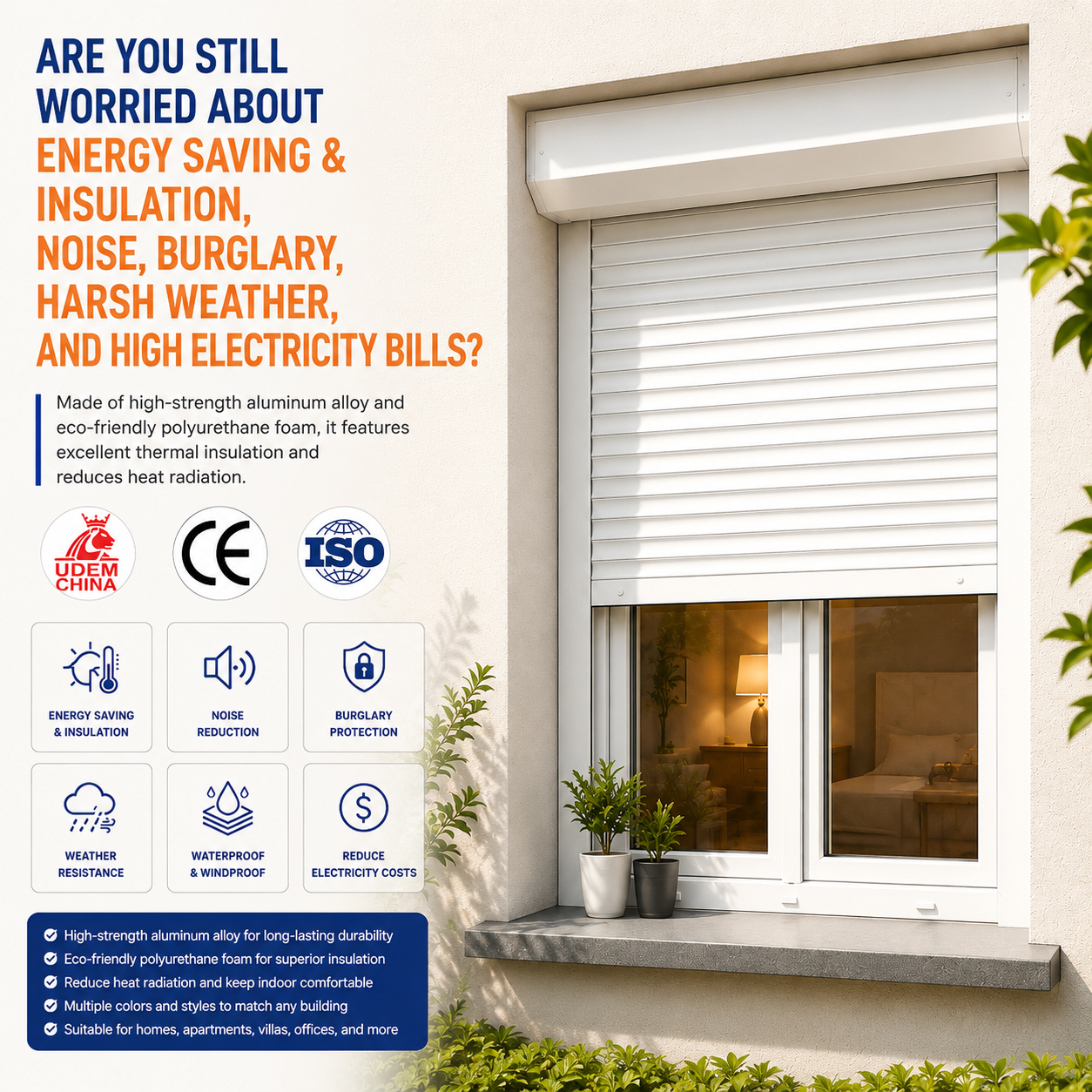

Aluminum roller windows are roll-up window systems built from extruded aluminum slat profiles, designed to secure and enclose window openings in residential, commercial, and hospitality buildings. Unlike fixed grilles or traditional sliding windows, aluminum roller window systems roll upward into a compact hood box mounted above the opening, keeping the facade clean when the window is open and providing physical protection when closed. The category covers roller shutter window configurations built from insulated aluminum slats — which deliver security, thermal insulation, and noise reduction — as well as lighter roller configurations for sun shading and ventilation control.
The slat construction determines performance. Insulated slat profiles with polyurethane foam cores provide thermal resistance and acoustic attenuation that hollow or single-skin aluminum profiles cannot match. As energy codes in markets such as the UK, the Netherlands, and North America tighten baseline performance expectations for commercial fenestration, that distinction becomes increasingly relevant to specification-driven procurement.
When evaluating aluminum roller windows from a specification perspective, the performance variables that matter most are not always the most visible in a product listing. The following characteristics define the functional differences between products that look similar on a catalog page:
Aluminum roller windows serve a range of building types and use cases with different performance priorities. The application context shapes which specification variables deserve the most attention.
Residential and hospitality buildings: Villas, apartments, hotels, and serviced accommodation use aluminum roller windows for security, privacy, and thermal comfort. In hot climates — including Saudi Arabia and other Middle East markets, as well as south-facing commercial facades in tropical regions — insulated roller windows help manage solar gain, reducing cooling loads and improving occupant comfort. In these environments, track system durability under sustained high ambient temperatures is worth evaluating carefully. Aluminum roller windows with lower-quality extruded track profiles can show deformation and operating resistance over time when exposed to prolonged heat, which is rarely obvious from product photography or standard specification sheets.
Commercial buildings and storefronts: Offices, schools, retail storefronts, service counters, and hospitality venues use roller windows for after-hours security and daytime privacy control without permanent barrier grilles that affect the facade appearance. Rolling fully into a compact hood box when open is a functional distinction from fixed security grilles — the facade remains unobstructed during operating hours, which matters for branded retail environments and public-facing buildings where visual presentation is a design requirement.
Container houses and modular structures: Container house fenestration presents a specific framing challenge, as standard window frame systems are not always dimensionally compatible with container wall thicknesses. Aluminum roller window products designed with adjustable frame depth options and container-compatible mounting profiles simplify specification for developers and contractors working with modular structures. Drainage channel integration is also more relevant in container house assemblies than in conventional masonry construction, given the way water is managed across metal-panel wall systems.
Small commercial openings — kiosks, counters, and display cases: Lightweight roller shutter configurations for smaller commercial openings require products engineered for frequent daily cycling. In these applications, the durability of the operation mechanism and the smoothness of the slat guide system are more operationally relevant than thermal insulation performance.
Selecting aluminum roller windows starts with the application environment and the performance requirements specific to that context — not with the product catalog. The specification considerations for a coastal residential project differ meaningfully from those for a commercial office building in a temperate northern European climate, even where opening dimensions are similar.
One of the more avoidable complications in window procurement is ordering based on nominal opening dimensions without verifying the actual structural opening measurement at the installation site. Aluminum roller windows require close dimensional coordination between the slat guide tracks and the structural opening. A mismatch discovered at installation — particularly in retrofit projects where openings may have been built to imprecise tolerances — creates a problem that is significantly more expensive to resolve than a dimensional verification step before finalizing the order.
For outdoor and mixed-climate installations, surface treatment durability and drainage design deserve deliberate attention. Sealant degradation at the frame perimeter — particularly along the lower track seal — is typically the first failure mode that emerges in demanding environments, and it is rarely captured in standard product descriptions. Asking about drainage channel provision and gasket material specification is a reasonable part of supplier qualification.
Key specification questions before finalizing an order:
Aluminum roller windows carry a cost premium over steel-framed or uPVC alternatives that is grounded in genuine performance and lifecycle differences. Aluminum extrusions provide a better strength-to-weight ratio than steel in window-scale applications, which supports smoother operation mechanisms and allows more slender frame profiles without sacrificing structural integrity. Corrosion resistance under normal atmospheric conditions — including coastal and urban environments — is substantially better than steel without a paint coating, which reduces the ongoing maintenance and recoating costs that affect total cost of ownership in long-installation-life applications.
The aesthetic positioning also matters in commercial and hospitality contexts. Powder-coated aluminum roller windows integrate with designed building facades in a way that painted steel or PVC systems typically do not. For commercial buyers specifying across multiple units or properties, that consistency has value beyond the individual window cost.
For B2B procurement at project scale, the evaluation should move beyond unit price to include profile system quality, custom size capability, surface finishing precision, quality control process, and packaging standards for international shipment. Experienced procurement teams in commercial construction routinely work through these dimensions when qualifying overseas suppliers — and the suppliers that can engage substantively across these areas are typically the ones with the production discipline to deliver consistent quality across a multi-unit order.
Copyright © 2026 By Qingdao Voltor Door Industry Technology Manufacturing Co., Ltd. - Privacy policy
 EN
EN