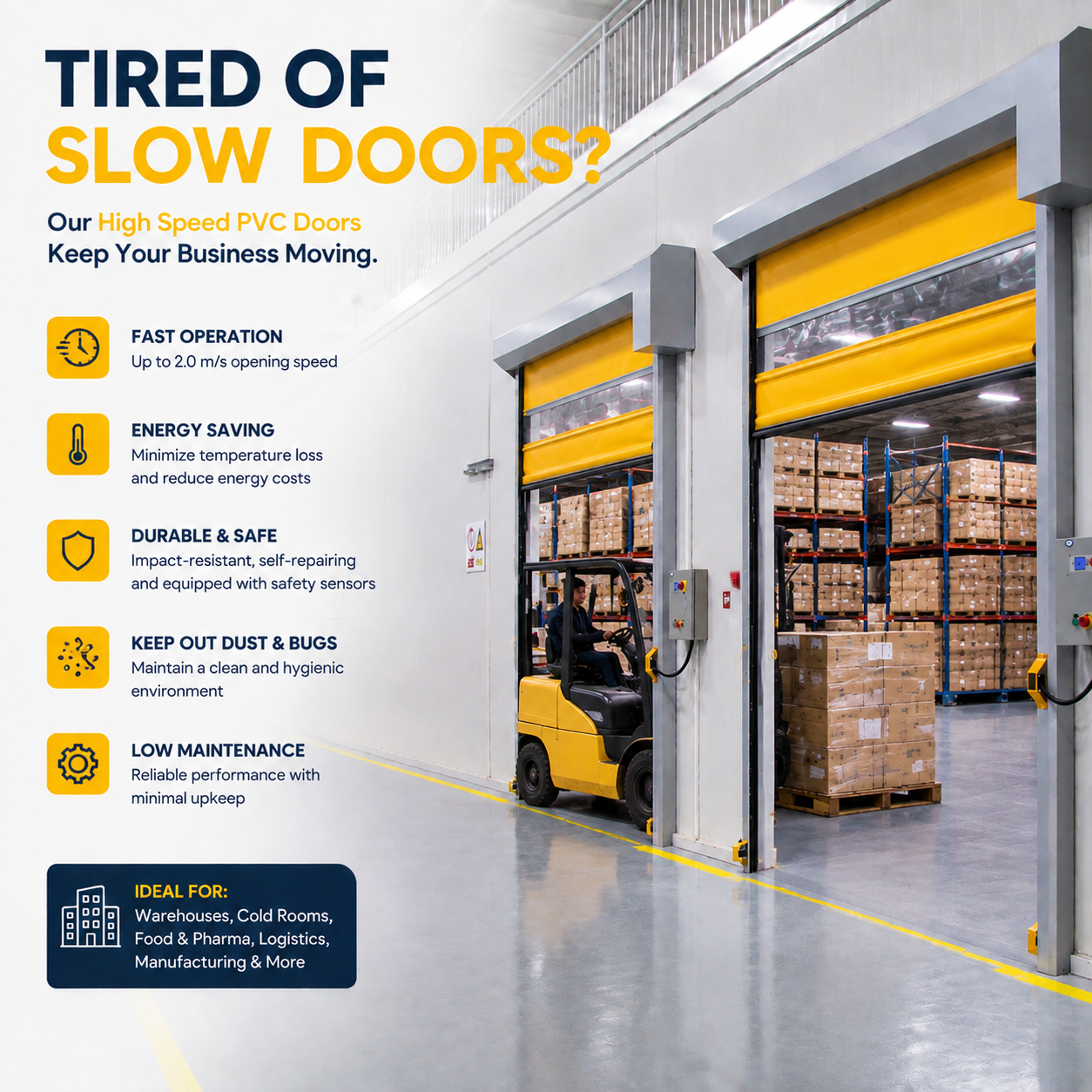
Fast doors — also called high-speed doors or rapid roll-up doors — are industrial door systems engineered for environments where standard doors create bottlenecks, energy loss, or contamination risk. Unlike conventional sectional or roller shutter doors, fast doors operate at speeds typically ranging from 0.8 to 2.0 meters per second, completing an open-close cycle in seconds rather than minutes. This speed matters less as a specification headline and more as a functional threshold: once a facility runs forklifts, conveyor systems, or climate-controlled zones, the gap between a standard door's 8-second cycle and a fast door's 2-second cycle compounds across hundreds of daily operations into measurable energy savings and throughput improvement.
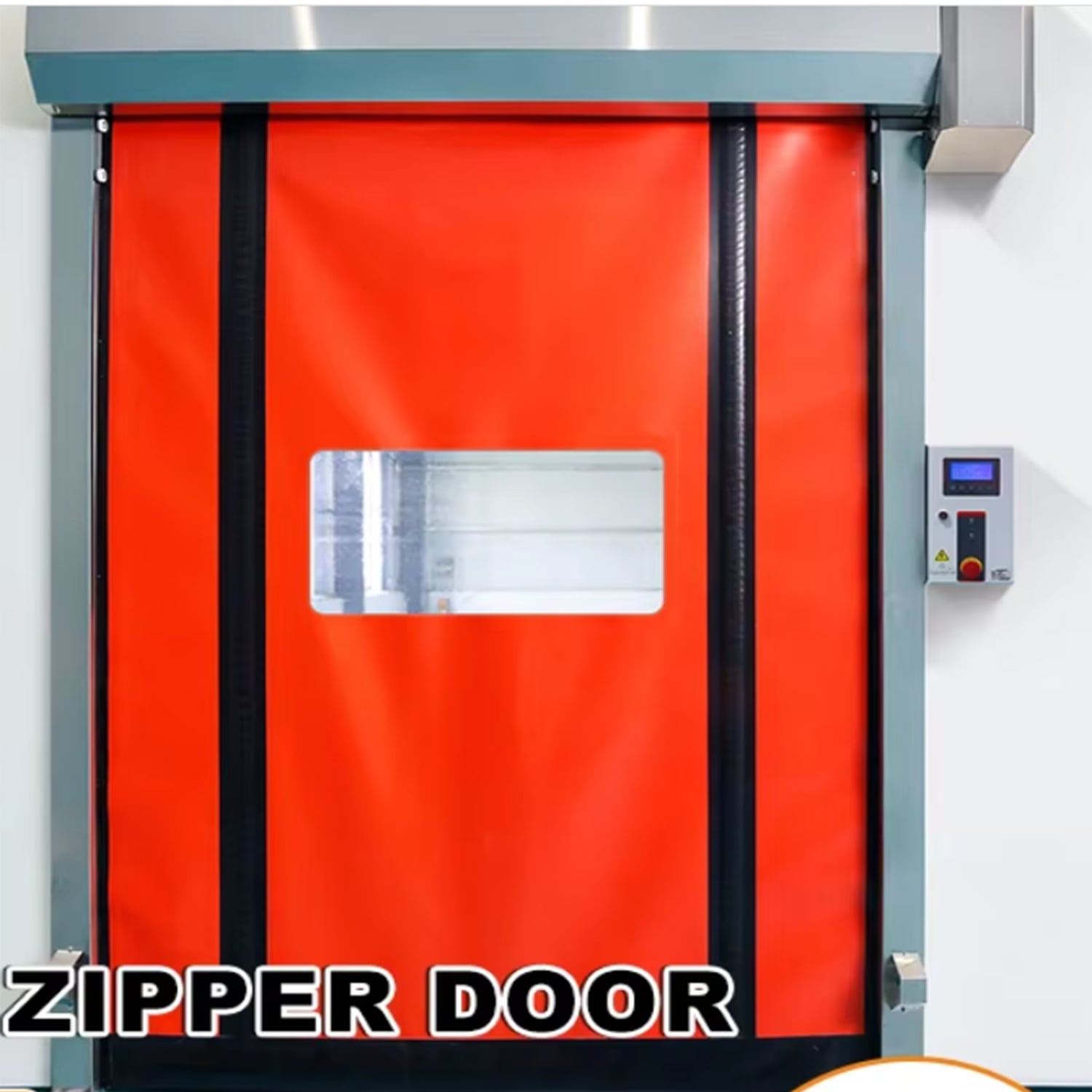
This category covers four fast door types: PVC zipper rolling doors, PVC stacking doors, PVC high-speed roll-up doors, and aluminum alloy turbine hard high-speed doors. Treating them as interchangeable based on price or appearance is a procurement mistake that becomes visible after installation.
The four fast door types in this category differ primarily in curtain material and construction, structural mechanism, and target operating environment — not just price tier.
Fast doors serve environments where standard door types are inadequate. Relevant applications vary by fast door type and operating context.
In cold chain and refrigerated warehouse settings, fast doors reduce warm-air infiltration during each open cycle. The thermal performance — both curtain insulation and perimeter seal integrity — affects energy consumption in a way that compounds over thousands of daily cycles. For cold storage, the aluminum turbine hard option or insulated PVC roll-up provides better thermal separation than a standard soft-curtain configuration.
In food processing and pharmaceutical manufacturing facilities, the priority shifts from thermal performance to hygiene control. Dust, insect, and airborne contaminant exclusion depends on both door speed and seal quality at the perimeter. The self-repairing zipper track mechanism is particularly relevant here: facilities operating under strict hygiene protocols often cannot tolerate the downtime of a manual curtain re-threading after a minor impact event.
In logistics and distribution centers, high traffic frequency is the primary specification driver. A loading dock running dozens of vehicle passages per hour generates significant cumulative energy loss from slow-closing doors. Fast door selection logic starts with daily cycle volume, then works back to determine which curtain material, motor type, and control system can sustain that load over a multi-year service horizon.
In automotive workshops, manufacturing plants, and general industrial facilities, fast door requirements vary. Some installations need rapid operation to separate work zones; others require impact resistance or specific clearance heights. The stacking fast door format handles large spans that roll-up drums cannot accommodate at equivalent structural weight.
Fast door procurement is specification-driven by necessity. The structural opening dimensions, operating frequency, environmental conditions, and safety requirements all need to be defined before a fast door product can be matched to an application. The spec sheet for a fast door looks straightforward on paper, but most experienced facility buyers will tell you the number that actually drives long-term cost is the expected cycle count before curtain, spring, or motor replacement — not the door's rated opening speed.
The specification questions that determine fast door selection are: What is the operating temperature range? What is the estimated daily cycle count? Is the installation indoor, outdoor, or at a pressure boundary between zones? What are the clear opening dimensions? What are the local requirements for safety sensors, emergency stop mechanisms, and manual release access? What is the proximity and frequency of forklift traffic to the door face?
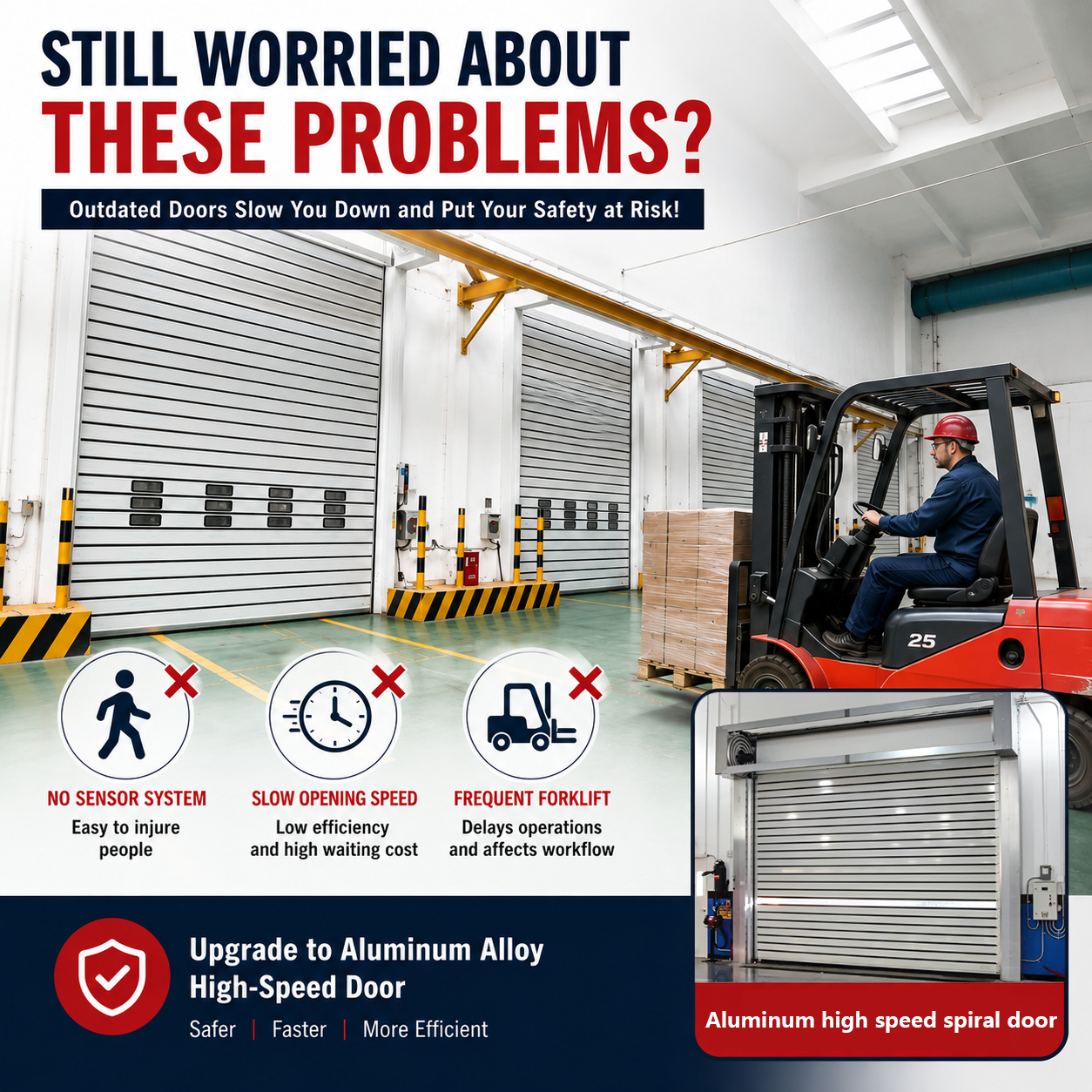
The difference between a PVC soft curtain fast door and an aluminum hard-slat door comes down to three things: the application's thermal requirements, the expected impact frequency from in-facility vehicles, and the long-term maintenance staffing available on-site. For a general warehouse with limited cold storage requirements, a PVC roll-up fast door is often the operationally appropriate and cost-efficient choice. For a cold storage facility with constant high-frequency traffic, the aluminum turbine hard door's structural performance and insulation value justify the higher procurement cost.
Workplace safety regulations in the US, EU, and Canadian markets increasingly require motorized commercial fast door installations to include safety edges, photo-eye sensors, and accessible emergency stop mechanisms. Buyers sourcing fast doors for regulated markets should confirm which safety features are standard and which require separate specification — this affects both insurance compliance and operational liability.
The fast door category requires production systems and component sourcing optimized for high-cycle industrial door performance. A manufacturer whose design focus is on industrial doors — rather than a generalist factory producing multiple unrelated product lines — provides more reliable alignment between what is specified, what is produced, and what performs over the product's service life.
One thing that becomes clear evaluating fast door performance in daily use is that longevity is at least as much a function of motor quality, spring selection, and curtain fabric specification as it is of the door's marketed operating speed. The motor is under continuous load in high-cycle environments; the spring mechanism is under tension with every open cycle; the curtain fabric is subject to UV exposure, temperature cycling, and impact stress. These are the components that determine whether a fast door delivers its rated service life or requires premature replacement.
A product range covering both soft PVC curtain fast door types and hard aluminum slat doors — across multiple operating mechanism formats — allows buyers to maintain a single supplier relationship as facility requirements evolve. A warehouse that begins with standard roll-up doors for general access and later adds a refrigerated zone can expand to aluminum hard doors for cold storage without establishing a new supplier relationship or learning a different product ecosystem.
For international buyers sourcing fast doors, export documentation accuracy, packaging for ocean freight, and communication support during and after the order are all part of the total sourcing calculation. Buyers in the US, UK, Saudi Arabia, Netherlands, Brazil, and Japan may also need documentation to satisfy import compliance, building permit, or insurance underwriting requirements. Sourcing from a manufacturer with active multi-market export experience reduces the documentation and logistics coordination burden that falls to the buyer in these markets.
Copyright © 2026 By Qingdao Voltor Door Industry Technology Manufacturing Co., Ltd. - Privacy policy
 EN
EN