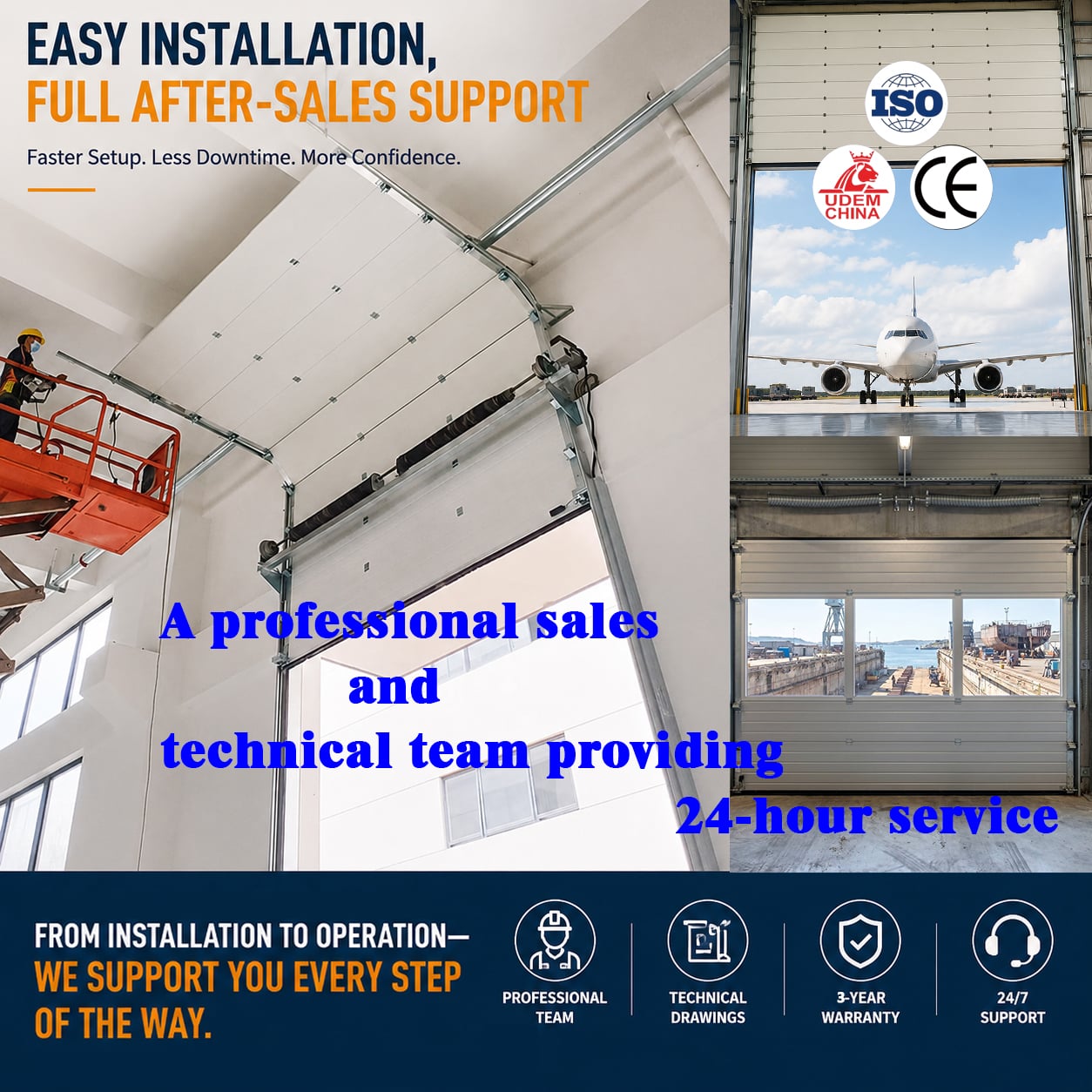

Sectional industrial doors are overhead closure systems designed for commercial and industrial facilities that require reliable, repeatable access control at large openings. Unlike single-panel swing or horizontal sliding doors, sectional industrial doors operate on a vertical lift mechanism — panels fold upward along a guide track system, allowing the door to open and close without encroaching on interior or exterior floor space. This makes them a practical choice for facilities where vehicle access, loading operations, and operational throughput must coexist within a constrained building footprint.
The standard panel construction for sectional industrial doors uses color-coated steel or aluminum sheets as facing materials, filled with polyurethane foam insulation. Internal and external reinforcing ribs integrated into each panel provide structural stiffness, allowing the door to maintain its form under wind pressure and repeated mechanical cycling. This construction balances thermal efficiency, structural integrity, and long service life — which is why sectional industrial doors have become the dominant overhead closure choice for warehouse and industrial facility applications across global markets.
Understanding how a sectional industrial door performs in real use requires looking beyond the surface-level specification sheet. The specification sheet for a sectional industrial door may confirm panel thickness and insulation fill, but the parameters that drive day-to-day operational reliability — spring cycle rating, seal compression resistance, and track load tolerance — are less consistently documented across suppliers and deserve direct verification before order commitment.
Sectional industrial doors serve a broad range of commercial and industrial facility types. The vertical operation mechanism and insulated construction make them especially well suited to facilities where temperature management, weather exclusion, and frequent vehicle or forklift access are simultaneous operational requirements.
Warehousing and logistics facilities represent the largest application segment. The sustained growth in e-commerce fulfillment infrastructure across North America, Europe, and Asia has driven significant demand for sectional industrial doors in distribution centers and logistics hubs, where consistent door operation and thermal efficiency directly influence energy costs and loading throughput.
Manufacturing plants use sectional industrial doors to separate production zones, control environmental conditions at large service openings, and manage access at vehicle marshaling areas. Loading dock applications require doors that can handle repeated truck-height openings with consistent cycle reliability — a context where spring and motor system selection matters considerably more than it would in a lower-frequency use case.
Agricultural buildings and rural facilities rely on sectional industrial doors for equipment access and environmental protection. Service centers — including vehicle maintenance facilities and commercial workshops — depend on wide-span opening capability and low-maintenance construction to support high-frequency access across multi-bay layouts. If the facility operates in a moderate climate with predictable opening patterns, a standard insulated panel configuration will usually be sufficient — but in cold storage or high-humidity environments, higher insulation values and enhanced seal specifications should be evaluated before finalizing an order.
From a procurement standpoint, the selection process for sectional industrial doors is largely specification-driven. Buyers who approach the category with a clear application brief — structural opening dimensions, required thermal performance, expected cycle frequency, available headroom, and automation requirements — are better positioned to compare supplier offerings meaningfully and avoid specification mismatches after delivery.
The key selection criteria for sectional industrial doors include:
To be fair, the majority of standard warehouse applications perform adequately with a mid-specification sectional industrial door. The differentiation becomes meaningful when application conditions include thermal extremes, high cycle frequency, or structural exposure that places ongoing demands on the door performance and maintenance envelope.
In the first year of operation, most sectional industrial door installations perform to expectation on both access and weatherproofing. The divergence between product quality levels tends to emerge in year two and year three, when seal compression set — how much the gasket has permanently compressed under repeated closure — becomes the dominant factor in air and water infiltration performance. Buyers evaluating sectional industrial doors on initial cost alone often underestimate this downstream variable.
For facilities where the door is a component in an energy-managed envelope, long-term seal integrity has a measurable effect on heating and cooling costs. For facilities in dust-active or pest-pressured environments, the condition of edge and inter-panel seals after two to three years of regular operation is a meaningful quality differentiator that distinguishes specification-grade products from catalog-minimum alternatives.
Voltor's sectional industrial door range supports both manual and motorized operation configurations, allowing buyers to specify based on current automation requirements while retaining the ability to upgrade without replacing the primary door assembly. Spring mechanism selection in the Voltor industrial door range is calibrated for application-appropriate cycle life — aligning buyers with a specification that matches their actual operating frequency rather than the industry minimum. For buyers sourcing sectional industrial doors for distribution centers, logistics facilities, manufacturing plants, or agricultural installations across markets including the US, Canada, the UK, Saudi Arabia, the Netherlands, Brazil, Argentina, and Japan, Voltor offers a product range engineered for industrial-grade durability, backed by direct factory manufacturing capability and international export experience.
Copyright © 2026 By Qingdao Voltor Door Industry Technology Manufacturing Co., Ltd. - Privacy policy
 EN
EN